
Body doubling might not be a term you have come across, but the chances are you may already be using it intuitively. If you work better being around other people, even when they aren’t undertaking the same task, you may already be employing this technique. Body doubling can be described as a strategy which uses the presence of other people to help you stay focussed on a task.
Written by Helen Briscoe
Types of body doubling?
You may be aware of this practice even if you are not familiar with the term ‘body doubling’, some examples include:
- Study groups – the opportunity to work independently but situated within a wider group is a common and effective study technique
- Writing retreats – authors whether new, or established, use retreats where they work alone but in the presence of others to jumpstart their productivity or move past writers block
- Running groups – any form of exercise that can be done in groups, helps members to stay motivated, and can distract from the mental challenge of undertaking it alone

The science behind body doubling
Moving from being independent individuals to working in group situations is not a new idea, in fact it is well established in child psychology. Developmental psychology notes a specific period of a child’s life where they move from solitary play to playing in parallel with other children – often on separate activities.
This concept of parallel play has started to gain traction as a tactic used now by adults who engage in independent activities but are close to friends or loved ones whilst doing so. It enables a happy medium between social interaction and alone time. While the idea of ‘parallel play’ among adults often focuses on leisure activities and hobbies, it is also incredibly effective for work and study, where it is more commonly referred to as ‘body doubling’.
Body doubling and neurodiversity
Body doubling as a practice originally emerged from self-help strategies employed by neurodiverse people to stay motivated when faced with frustrating or boring jobs (Villines, 2024). However, it is now recognised as an effective accountability technique for a range of tasks, including exercising, undertaking household tasks, and studying.
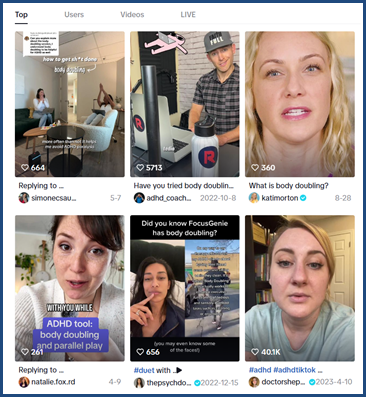
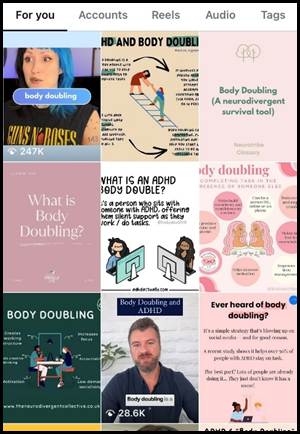
It is so popular as a strategy for people with ADHD that TikTok (#ADHDtok) has a whole category dedicated to content sharing hacks like this (#ADHDhacks #BodyDoubling). Instagram also offers many accounts to support body doubling, including options to join Instagram Live study with me sessions while you work or study.
Body doubling as a study strategy
As a student, you can use the strategy of body doubling to increase motivation and accountability, as well as reducing distraction and procrastination. We wouldn’t be doing our jobs if we didn’t underpin these ideas with evidence! So …
- Many people have naturally employed this strategy for years without realising that it even has a name (Eagle, Baltaxe-Admony and Ringland, 2024).
- Recent research by Danvers and Wells (2025) identified that when students work in close proximity to others, it increases their feelings of accountability, therefore making their study time more productive.
- Importantly, they do not need to be undertaking the same tasks, or even aware of what the other person is doing for this technique to be effective (Eagle, Baltaxe-Admony and Ringland, 2023).
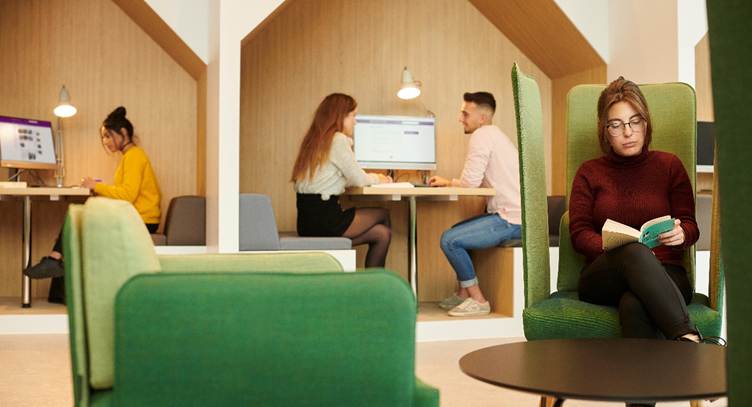
- While this technique appears to be effective anywhere, university students often choose space on campus rather than their home for more focussed study, finding that presence of others nearby has a positive impact upon keeping them motivated (Danvers and Wells, 2025).
Ready to give body doubling a go?
Body doubling is something you can do physically, or virtually, alongside strangers, or with people you know. Why not try one of the following strategies to see if it helps you to study?
- Gather a group of friends and book a shared study space in Catalyst
- Hang out in a local coffee shop where other people are also working
- Join an online body doubling live-stream session
- Hang out in the fab new Students’ Union building where there are plenty of spaces to study as well as relax
The benefits of body doubling
The benefits of trying body doubling as a study strategy is that it offers flexibility to find out what works best for you. Whether that is the opportunity to work in companionable silence with friends, immersing yourself in the background buzz of a coffee shop, or just finding increased motivation by being near others who are working.
Have you already tried any of these strategies? Did they work for you? Any other recommendations? Feel free to share your experiences and tips with us @EHULibrary
Read more about body doubling
DANVERS, E. and WELLS, A., 2025. The homeification of learning in higher education. Higher Education Research & Development [online]. 44 (1), pp. 33-48. Available from: https://www.tandfonline.com/doi/full/10.1080/07294360.2024.2429441
EAGLE, T., BALTAXE-ADMONY, L. B. and RINGLAND, K. E., 2023. Proposing Body Doubling as a Continuum of Space/Time and Mutuality: An Investigation with Neurodivergent Participants. In: ASSETS ’23: Proceedings of the 25th International ACM SIGACCESS Conference on Computers and Accessibility, 22-25 October 2023, New York, NY [online]. Article No: 85, pp. 1-4. Available from: https://doi.org/10.1145/3597638.3614486
EAGLE, T., BALTAXE-ADMONY, L. B. and RINGLAND, K. E., 2024. “It Was Something I Naturally Found Worked and Heard About Later”: An Investigation of Body Doubling with Neurodivergent Participants. ACM Transactions on Accessible Computing [online]. 17 (3), pp.1-30. Available from: https://dl.acm.org/doi/pdf/10.1145/3689648
VILLINES, Z., 2024. What is ‘body doubling’ for ADHD? [online]. Available from: https://www.medicalnewstoday.com/articles/body-doubling-adhd
