
Written by Madeline Mayer, BA (Hons) Working and Teaching in the Early Years

Madeline Mayer is a Y3 student on the BA (Hons) Working and Teaching in the Early Years programme at Edge Hill University
As sport is often celebrated as a place of inclusion, health, and enjoyment, it still reflects deeply rooted gender stereotypes and inequalities. From a young age, children are often steered toward gendered expectations —football and rugby for boys, dance, and gymnastics for girls —limiting their freedom to explore, express, and excel in activities of their choosing. This issue isn’t just cultural it is legal and political. Article 2 of the United Nations Convention on the Rights of the Child (UNCRC) guarantees non-discrimination, while Article 13 upholds a child’s right to express themselves. Article 28 ensures their right to a quality education. Yet despite these protections, research conducted by Mao, (2023) and Jost, (2024) continues to show disparities in opportunity, representation, and support for girls in sport. Sonia and Vasilica, (2019) address the fact that females are still underrepresented in coaching and leadership roles, receive less funding, and are often sexualized or overlooked in media coverage. Although there are campaigns out there such as ‘women in sport’ who are influencing sports, schools, local councils, and national government to ensure sport in open to all women and girls there is no initiatives I have encountered that fight for all gender roles within early years sport.
Within the early years there are many issues related to gender equality such as the reinforcement of gender stereotypes through toys, the impact of adult expectations and biases, and the negative self-perception in children who do not conform with gender norms (Sukesi et al., 2020). This systemic inequality extends into the early years. The Early Years Foundation Stage (EYFS, 2024) highlights the vital role of physical development in childhood, linking gross motor skills with well-being, confidence, and future success. However, when access to certain sports is gendered, we risk denying children not only physical benefits but also emotional growth, creativity, and lifelong passion. In relation to my campaign, it is significant that there are issues on gender equality in early years sports for example activities and language, which limit children’s potential by associating certain behaviours with specific genders and unequal play opportunities.
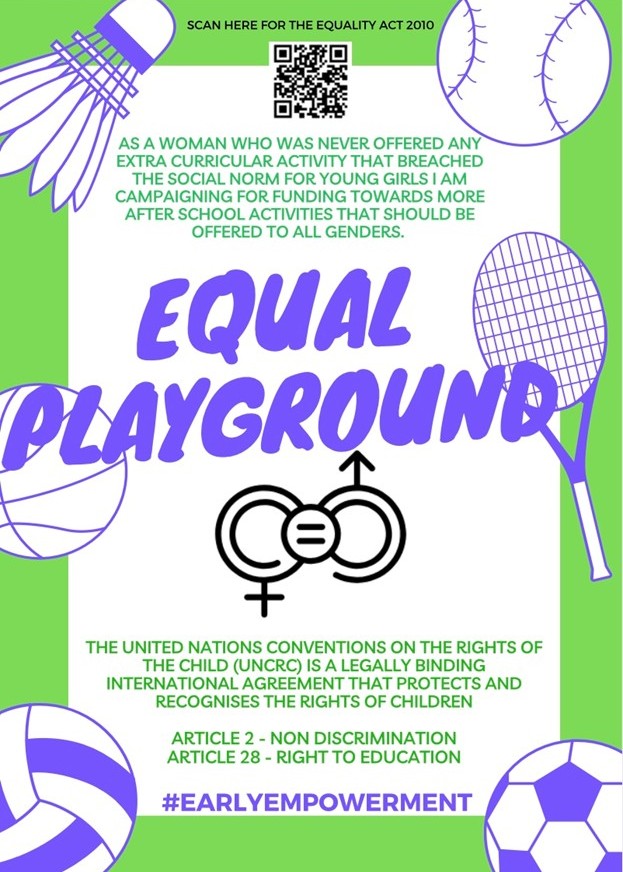
Equal Playground campaign flyer.
The Equal Playground campaign aims to combat this. It seeks to create inclusive after-school and early years sports programs that offer equal access, representation, and support for every child—regardless of gender. This initiative will provide schools and nurseries with posters, staff training, and workshops tailored to breaking down gender stereotypes in sport. Social media efforts using #EarlyEmpowerment will feature athletes who defy norms, providing diverse role models that inspire all children. Importantly, this campaign doesn’t exclude boys. It challenges all forms of gender stereotyping, advocating for environments where every child feels safe exploring activities outside societal expectations. Aligning with Sustainable Development Goals 5, 10, and 16, Equal Playground emphasizes equality, inclusion, and the right to express oneself freely.
As a woman who had no access to non-traditional extracurriculars growing up, I know first-hand how early reinforcement of gender norms can limit a child’s self-belief. But it doesn’t have to be this way. With collaboration between teachers, parents, and policymakers, we can cultivate inclusive sporting environments that celebrate diversity and empower every child. The early years of all children’s lives are critical. Stereotypes picked up in childhood shape identity, motivation, and future choices. Role models, media representation, and inclusive education matter. Bandura’s Social Learning Theory reminds us that children imitate what they see. So, let’s ensure what they see is equality, opportunity, and encouragement.
Gender equality in early years sport is not just a campaign—it’s a movement to help all children grow into confident, resilient individuals with the freedom to pursue their passions. Together, we can make sporting environments a place where every child feels a sense of belonging.
Reference list
Department for Education, 2024. Statutory framework for the early years foundation stage. For group and school-based providers. London: Department for Education (DfE).
FENTON-GLYNN, C., 2019. Children’s rights and sustainable development: Interpreting the UNCRC for future generationsCambridge University Press.
JOST, P., 2024. No title. Breaking Barriers: Gender Equality in European Sports Leadership: A Comparative Case Study of Ireland and Germany.
MAO, Y., 2023. Gender Stereotypes/Discrimination Females Experience in Sports-Related Occupations. Journal of Education, Humanities and Social Sciences. 12, pp. 224–228.
SONIA, A. and VASILICA, G., 2019. Gender equality in sport organizations. Ovidius University Annals, Series Physical Education & Sport/Science, Movement & Health. 19 (2), pp. 81–89.
SUKESI, K., MALIHAH, E., HASANAH, V. R., WIDANINGSIH, L., SETIAWATI, E., KISRIYANI, A., SAPTANDARI, E. W., NURHADI, I. and INGGRIDA, J. A., 2020. Early childhood character education based on gender equality and social inclusion. In: 2nd International Conference Innovation in Education (ICoIE 2020)Atlantis Press. pp. 121–126.
UNITED NATIONS, 2015. [online] available from https://sdgs.un.org/goals/goal4 access date [04/06/2025].
UNITED NATIONS CONVENTION ON THE RIGHT OF THE CHILD, 1989. UNCRC [online] available from https://www.unicef.org.uk/what-we-do/un-convention-child-rights/ access date [04/06/2025].
Figure list Figure 1 – The Mother Baby Centre, (2023). Why gender-inclusive parenting is becoming more popular.https://www.themotherbabycenter.org/blog/2023/05/gender-inclusive-parenting/
