
Written by Holly Grice, BA (Hons) Working and Teaching in the Early Years

Holly Grice is a student on the BA (Hons) Working and Teaching in the Early Years programme at Edge Hill University
Why is something as natural as feeding a baby still so complicated and controversial to talk about?
We have all heard stories from parents about how breastfeeding was a breeze or was the most painful experience of their life; some parents may feel anxiety around breastmilk and pumping, while others are advocates. Sometimes, it’s not the parent’s choice as the main goal for many is to feed their child; however, for some parents, information sharing, research and experience can influence how they perceive child nutrition. While breastfeeding is recommended, many parents struggle with the process due to misinformation and lack of support (Minter, 2019). Companies may often use parental fears to push their products which disregards the importance of child nutrition and health. With all this, feeding choices – breastmilk or formula – should be supported through education and well-educated healthcare professionals, not shame or anxiety.
Breastmilk is widely understood as the optimal nutrition for babies and infants. Breastfed children tend to show better growth, neurological development and immune system (Muro-Valdez et al., 2023). While both options should be available to parents without shame, some mothers or parents of the same sex may not have the option to breastfeed. The reality is more complex; every parent should listen to their body and their child’s body to create decisions on top of information from professionals. However, factors such as aggressive marketing, exploiting fear and social media can influence how parents make decisions and conduct their daily routines with their children.
Potentially, as a society, we are too well-informed from information overload caused by the social media and digital age. There is a vast amount of information around lifestyle, motherhood and parenting through news articles, social media, research and videos, especially when platforms use algorithms to personalise what we access (Xu et al., 2024). Unknowingly, information on child nutrition can be sourced from clever marketing techniques. While laws around this exist such as the International Code of Marketing of Breast milk Substitutes (WHO, 2017), the usage of formula feeding has been swayed by formula companies who use anxiety and fear which often comes when making decisions around your child’s health and brand loyalty often plays a big part in this – despite any controversies or mishaps the brand have faced (Hillger, Kirch and Wolfram, 2024; Hastings et al., 2020; Nichols et al., 2023). One example of such is the Nestlé scandal during the 70s. The company used unethical marketing techniques such as sponsoring scientific events, offering healthcare aid to health professionals and funding research (Velasco, Oliveira and Boccolini, 2022) which may lead to an unknown bias from healthcare providers and professionals.
On top of navigating child nutrition, post-COVID saw inflation, tighter supply chains and household bills spiking – especially when many UK households saw income decrease. Therefore, families using formula milk may have had to make the decision on what is classed as essential to buy. This meant that parents were stretching their formula milk as far as possible and even diluting it (Marino et al., 2023) which interferes with health as serving sizes are there to ensure proper child nutrition. This links in with the United Nations 17 Sustainable Goals (United Nations, 2024) which covers a goal to end hunger, achieve food security and improve nutrition. Without financial support or changes to formula production, promotion and pricing then parents struggling in the cost-of-living crisis (Ellison, 2023) will not be able to continue to afford formula. Furthermore, two of the aspects we see in the goal is to achieve food security and better nutrition, but formula companies have shown disparities in their production and pricing. It is significantly cheaper for a company to make formula milk than what retail price is. Formula companies often use clever marketing techniques to maximise their profits (Hastings et al., 2020) meaning children’s health is not prioritised. Furthermore, instant formula milk contains far too much sugar than what is recommended which will increase unhealthy weight gain for many babies (Ling Kong et al., 2021). Therefore, there must be a call to action.
Education, advocacy and training is important when considering the changes needed for bettering formula milk and making it more accessible for everyone. Education around the benefits of breastmilk is important but also understanding the needs of formula milk and how to prepare and serve it for babies without judgement. Research shows that only 18.9% of mothers received advice on formula milk prior to using it from healthcare professionals (Appleton et al., 2022) meaning that parents decision making is ill-informed. Awareness of the benefits to both breastmilk and formula milk is very important when giving advice to parents; however, the misleading information is also important to acknowledge so parents are aware of disparities and are less confused or anxious in their decision making. Advocacy and training are also important as change to formula regulation, sugar content, clearer labels and pricing is vital to create more sustainable and child-focused formula. Likewise, advocacy for policy change around making time for pumping and providing spaces for it to be done is important to promote healthy breastmilk production. Finally, early childhood and educational practitioners require training since they frequently serve as a large support network for parents who use nurseries and early childhood institutions (McGuire et al., 2019). This means that educators can provide some nonjudgmental information to parents about their options.
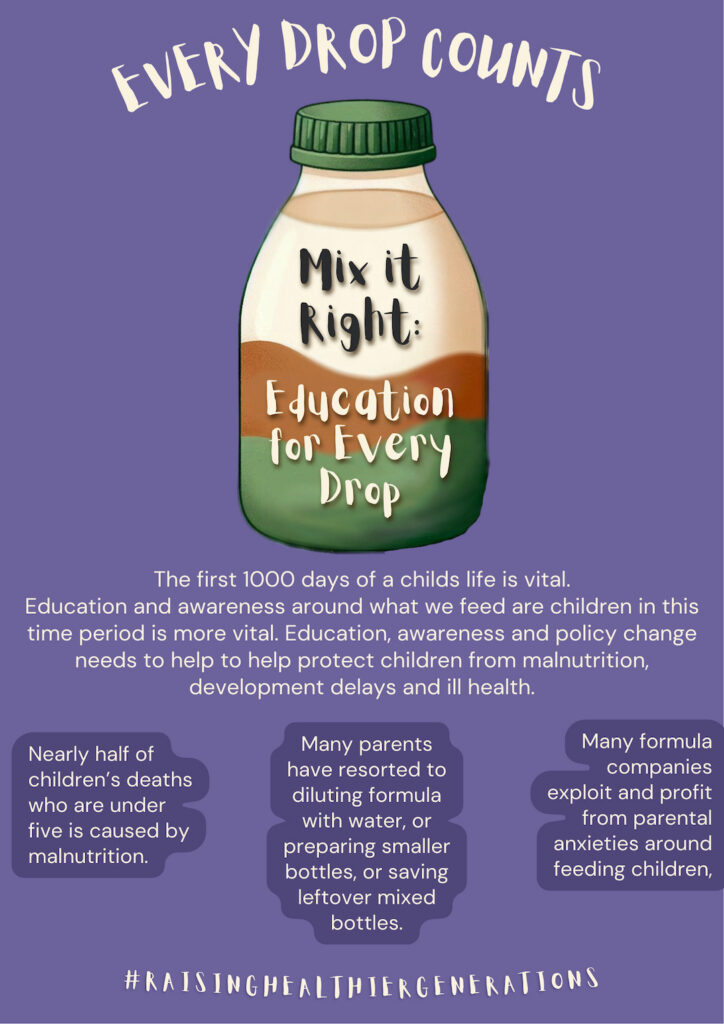
Every Drop Counts poster
Whether milk comes from breast or bottle, children’s welfare should be at the centre of decision making: choices should be well-informed, respectful and equitable. Shame is never the option to picking a feeding method, what really matters is that every child’s needs are met so they can grow, develop and achieve (UNICEF, 1989). But to achieve this, we need more than just personal preference – we need education, advocacy, accountability and empathy from the environments and systems around the child and family. When we support families with information based on research, when we challenge aggressive marketing and when we create spaces for parents to feed comfortably, we are ensuring children remain at the centre. Every drop counts. Therefore, interventions and workshops should consider opportunities for learning and information sharing so parents and society are better informed.
Now it’s time to consider how we change our thinking around nourishment – not just for babies, but for the environments, information perceived and conversations which shape their development.
REFERENCE LIST
APPLETON, J., RUSSELL, C.G., FOWLER, C., JANSEN, E., BURNETT, A.J., ROSSITER, C., and DENNEY-WILSON, E., 2022. Informing Infant Nutrition: Timing of Infant Formula Advice, Infant Formula Choice and Preparation in the First 6 Months of Life. Journal of Nutrition Education and Behavior [online]. 54 (10), pp. 908–915. Available from: https://www.jneb.org/article/S1499-4046(22)00419-5/fulltext [Accessed 26 Feb 2025].
ELLISON, M., 2023. The Cost-of-Living Crisis in the UK: an Economy on the Edge. Colloquium [online]. 9788855130974, pp. 143–163. Available from: https://www.ledonline.it/ledonline/NS-097/unione-europea-crisi_08.pdf [Accessed 8 Jun 2025].
HASTINGS, G., ANGUS, K., EADIE, D., and HUNT, K., 2020. Selling Second best: How Infant Formula Marketing Works. Globalization and Health [online]. 16 (1). Available from: https://globalizationandhealth.biomedcentral.com/counter/pdf/10.1186/s12992-020-00597-w.pdf [Accessed 27 Feb 2025].
HILLGER, C., KIRCH, W., and WOLFRAM, N., 2024. Public Health Nutrition. Italian Journal of Public Health. 5 (1).
LING KONG, K., BURGESS, B., MORRIS, K.S., RE, T., HULL, H., SULLIVAN, D., and PALUCH, R., 2021. Association between Added Sugars from Infant Formulas and Rapid Weight Gain in US Infants and Toddlers. The Journal of Nutrition. 155 (2).
MARINO, J., MERAZ, K., DHALIWAL, M., DENISE DIAZ PAYAN, WRIGHT, T., and HAHN-HOLBROOK, J., 2023. Impact of the COVID‐19 Pandemic on Infant Feeding Practices in the United States: Food insecurity, Supply Shortages and Deleterious Formula‐feeding Practices. Maternal and Child Nutrition [online]. 19 (3). Available from: https://onlinelibrary.wiley.com/doi/pdfdirect/10.1111/mcn.13498 [Accessed 11 Feb 2025].
MCGUIRE, J., IRVINE, S., SMITH, J., and GALLEGOS, D., 2019. Australian early childhood educators and infant feeding: a qualitative analysis using social cognitive theory. Early Child Development and Care [online]. 191 (5), pp. 773–788. Available from: https://eprints.qut.edu.au/133486/1/33498972.pdf [Accessed 26 Feb 2025].
MINTER, C.I.J., 2019. Information to Help Families Meet Their Breastfeeding Goals. Journal of Consumer Health on the Internet [online]. 23 (1), pp. 83–93. Available from: https://digitalcommons.unmc.edu/cgi/viewcontent.cgi?article=1007&context=mcgoogan_articles [Accessed 9 Jun 2025].
MURO-VALDEZ, J.C., MEZA-RIOS, A., AGUILAR-USCANGA, B.R., LOPEZ-ROA, R.I., MEDINA-DÍAZ, E., FRANCO-TORRES, E.M., and ZEPEDA-MORALES, A.S.M., 2023. Breastfeeding-Related Health Benefits in Children and Mothers: Vital Organs Perspective. Medicina [online]. 59 (9), p. 1535. Available from: https://www.mdpi.com/1648-9144/59/9/1535 [Accessed 5 Jun 2025].
NICHOLS, B.S., KIRCHOFF, J.F., CONFENTE, I., and STOLZE, H., 2023. When Brands Behave badly: Signaling and Spillover Effects of Unethical Behavior in the Context of Triple Bottom Line Sustainability. Journal of Product & Brand Management [online]. 32 (6). Available from: https://www.emerald.com/insight/content/doi/10.1108/jpbm-07-2021-3569/full/pdf?title=when-brands-behave-badly-signaling-and-spillover-effects-of-unethical-behavior-in-the-context-of-triple-bottom-line-sustainability [Accessed 25 Feb 2025].
UNICEF, 1989. UN Convention on the Rights of the Child (UNCRC). UNICEF [online]. Available from: https://www.unicef.org.uk/what-we-do/un-convention-child-rights/ [Accessed 25 Feb 2025].
UNITED NATIONS, 2024. Goal 2 | End hunger, Achieve Food Security and Improved Nutrition and Promote Sustainable Agriculture. sdgs.un.org [online]. Available from: https://sdgs.un.org/goals/goal2 [Accessed 27 Feb 2025].
VELASCO, A.C. da C.F., OLIVEIRA, M.I.C. de, and BOCCOLINI, C.S., 2022. Harassment of Health Professionals by the Infant Food Industry at Scientific Events. Revista de Saúde Pública [online]. 56, p. 70. Available from: https://www.researchgate.net/publication/362316268_Harassment_of_health_professionals_by_the_infant_food_industry_at_scientific_events#fullTextFileContent [Accessed 8 Jun 2025].
WHO, 2017. THE INTERNATIONAL CODE OF MARKETING OF BREAST-MILK SUBSTITUTES Frequently Asked Questions [online]. Available from: https://iris.who.int/bitstream/handle/10665/254911/WHO-NMH-NHD-17.1-eng.pdf [Accessed 1 Jun 2025].
XU, C., LI, J., SUN, D., LI, J., ABDELZAHER, T., GRAHAM, J., MACY, M., LEBIERE, C., and SZYMANSKI, B., 2024. The Paradox of Information Access: on Modeling Polarization in the Age of Information. IEEE Transactions on Control of Network Systems [online]. 11 (2), pp. 964–976. Available from: https://www.researchgate.net/publication/375434936_The_Paradox_of_Information_Access_On_Modeling_Polarization_in_the_Age_of_Information#fullTextFileContent [Accessed 13 Jun 2025].
