
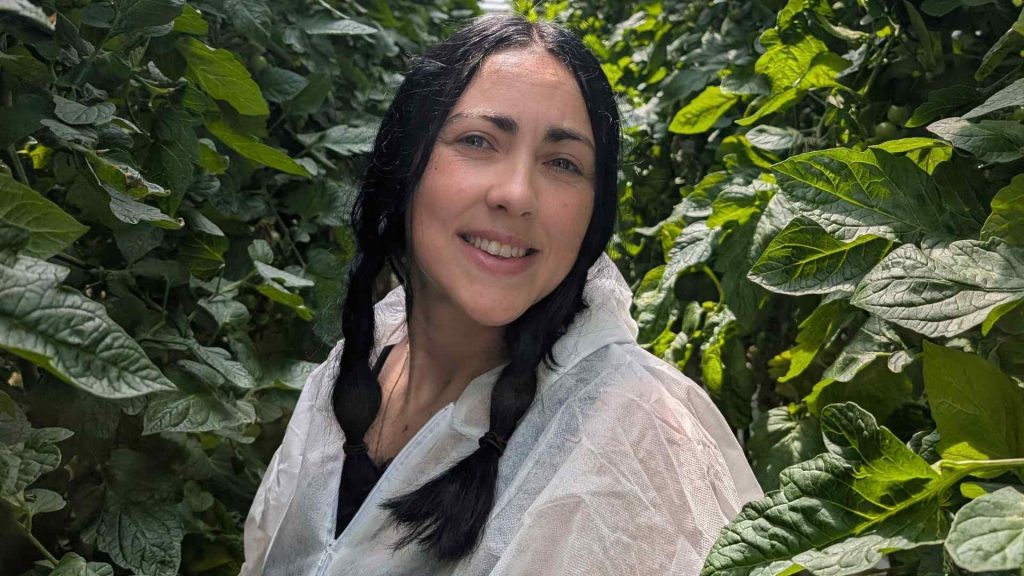
As part of her BSc (Hons) Plant Science dissertation at Edge Hill University, Sarah Treble undertook a research project exploring how environmental conditions within a commercial tomato crop influence plant stress responses. The study was conducted in partnership with Flavourfresh Salads, one of the UK’s leading greenhouse tomato producers, providing a unique opportunity to carry out research within a large-scale commercial growing environment rather than under laboratory conditions.
Modern greenhouse tomato crops are highly productive systems, but plants growing within dense canopies can experience very different conditions depending on where leaves are located within the crop. Upper leaves may receive high levels of sunlight, while lower leaves can remain shaded for much of the day. These differences create small ‘microclimates’ within the crop, which may influence plant health, productivity and stress responses.

Sarah’s project investigated whether the position of leaves within a tomato canopy, and the time of day at which samples are collected, influence measurements of plant stress. To answer this question, she collected hundreds of leaf samples from different canopy heights and at multiple time points throughout the day in a commercial greenhouse. Alongside this, light levels were monitored throughout the crop to understand how environmental conditions changed between canopy layers. The work involved extensive field sampling, laboratory analysis and data processing, providing valuable hands-on experience in both plant physiology and commercial horticultural research.
One of the most important outcomes of the project was highlighting that plants within the same crop do not necessarily respond uniformly to their environment. This has important implications for both researchers and growers. Many physiological measurements used to assess crop health rely on leaf samples, yet sampling protocols are often inconsistent between studies. Understanding how sampling position and timing influence results could help improve the reliability of future crop monitoring and research programmes.
The project also demonstrates the value of undergraduate research in addressing real-world challenges faced by industry. By working directly with a commercial grower, Sarah’s research contributed to a growing body of knowledge aimed at improving our understanding of crop performance in modern greenhouse systems. The findings are currently being developed further through additional data collection and follow-up studies. We are also preparing the work for wider dissemination to commercial growers and industry stakeholders, helping to translate academic research into practical knowledge that can support decision-making within the protected horticulture sector.
For Sarah, the project provided an opportunity to move beyond the classroom and contribute to a research area with direct relevance to food production, crop management and greenhouse innovation. It also highlights how student-led research can generate insights that continue to have value long after a dissertation has been completed.
To find out more about how you can support our students.
