
Poor air quality is often described as an invisible health risk. Yet for many families across St Helens and Warrington, its impact is anything but invisible, particularly for those living with respiratory conditions such as asthma and chronic obstructive pulmonary disease (COPD).
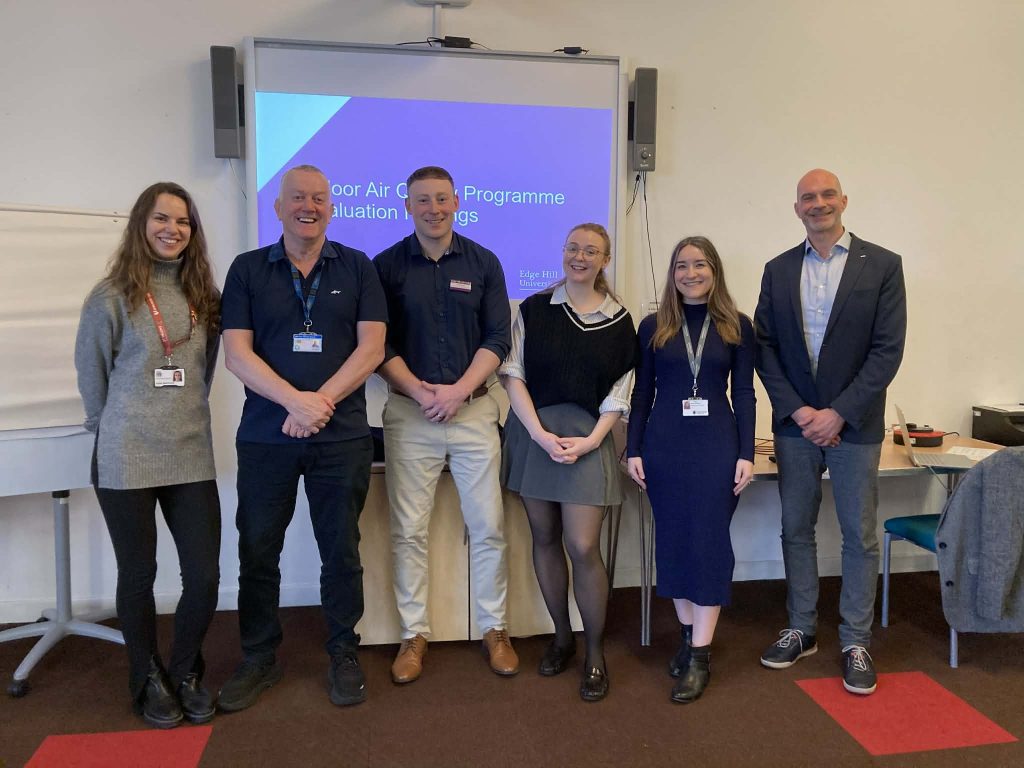
Working in partnership with St Helens Borough Council, Warrington Borough Council and City Health Care Partnership CIC, Edge Hill University’s Evaluation and Policy Analysis Unit (EPA) played a central role in evaluating the Healthy Air for Healthy Lungs programme, a DEFRA-funded initiative designed to help families better understand and improve the air quality inside their homes.
For the EPA team, the project was about far more than simply measuring outcomes. Alongside assessing the programme’s effectiveness, they worked to understand how meaningful change happened for participating families, what barriers they faced and how the initiative could be strengthened and expanded in the future. By combining robust research methods with close collaboration with delivery partners, the EPA helped create an evidence base capable of informing future public health policy and preventative health interventions.
Turning an invisible problem into something families could see
Communities across St Helens and Warrington experience higher-than-average levels of respiratory illness, with both indoor and outdoor air pollution contributing significantly to poor health outcomes. Despite this, many residents were unaware of how everyday household activities could affect the air they breathed or what practical steps they could take to reduce exposure.
The Healthy Air for Healthy Lungs programme aimed to change that. Families were provided with indoor air quality monitors alongside personalised advice and support, allowing them to see real-time changes in pollutant levels within their homes. Activities such as cooking, cleaning or even opening and closing windows suddenly became visible through live data.
For many participants, this marked a turning point. What had once felt like an abstract environmental issue became immediate, understandable and personal. Families could directly connect their daily routines with changes in indoor air quality, helping them feel more informed and empowered to make healthier choices within their homes.
Throughout this process, the EPA worked closely with delivery partners to capture not only the measurable outcomes of the programme, but also the lived experiences behind the data. Understanding how participants interpreted and responded to the information was a key part of evaluating the programme’s wider impact.
Building evidence to support better public health
The EPA’s evaluation combined quantitative data, including indoor air quality readings and service-level health data, with detailed qualitative interviews involving both participating families and programme staff.
Although the technical aspects of the evaluation were complex, the purpose remained clear, to understand whether the programme was making a meaningful and lasting difference in people’s lives.
Through interviews and ongoing engagement, the EPA identified a range of positive behavioural changes among participants. Families reported improving ventilation, changing cleaning products, adapting cooking habits and becoming more proactive in managing indoor air quality within the home.
Importantly, these changes were often sustained over time. Follow-up interviews suggested that many of the new behaviours had become embedded into everyday routines rather than short-term adjustments.
Parents also described noticeable improvements in their children’s health and wellbeing, including fewer respiratory symptoms and reduced visits to their GP.
Beyond individual households, the evaluation generated valuable learning for local authorities and healthcare partners. The EPA’s findings provided evidence to support future decision-making around preventative health programmes while also demonstrating how practical, community-based interventions can help address wider health inequalities.
The value of collaborative working
One of the project’s greatest strengths was the collaborative partnership that underpinned it from the outset.
The EPA worked closely with programme partners throughout delivery to ensure the evaluation reflected both academic rigour and the practical realities of working within communities. Rather than acting as a traditional “after-the-fact” evaluator, the team developed an ongoing, responsive learning process that helped support continuous improvement during the programme itself.
This collaborative approach enabled the EPA to move beyond simply reporting outcomes. By combining research expertise with local knowledge and frontline experience, the team was able to capture the practical challenges, adaptations and successes involved in implementing the programme across two boroughs.
The relationships developed throughout the project created a strong foundation of trust, openness and shared learning, strengthening not only the evaluation itself, but also the programme’s overall impact.
Aylish MacKenzie, Public Health Practitioner and Project Manager at St Helens Borough Council, said:
“Working with Edge Hill University on Healthy Air for Healthy Lungs really elevated the project. They were able to lead on the evaluation by bringing their research expertise and strong project management skills to ensure that the evaluation was carried out and communicated effectively.”
Roy Evans, Lead Project Coordinator for City Health Care Partnership CIC, added:
“I would just like to say it has been a pleasure and an honour to have been working with you and your team. I have learnt so much from this project which has enabled me to be more confident and allowed me to come out of my comfort zone. I really would like to thank you all for that.”
Creating long-term impact
While the programme delivered encouraging results, the EPA’s evaluation also highlighted opportunities for future development and longer-term impact.
One key recommendation focused on improving how programme data could be linked with NHS systems in order to better understand long-term health outcomes and patterns of healthcare use. Strengthening this evidence base would support future investment decisions and help shape policy development around preventative public health approaches.
The project also demonstrated significant potential for wider application. The EPA identified opportunities for the programme’s combination of real-time monitoring, education and personalised support to be adapted across other preventative health services and community health initiatives.
As the partnership continues, the EPA is also exploring how the project’s findings can be translated into accessible educational resources for healthcare professionals, helping them better support families in improving their home environments and respiratory health.
Reflecting on the project, Dr Oliver Hamer, Postdoctoral Research Fellow and Project Manager for the evaluation, said:

“Through our collaboration with St Helens Borough Council, Warrington Borough Council and City Health Care Partnership, the EPA team at Edge Hill University successfully delivered a robust evaluation that not only demonstrated impact but also generated a rich evidence base to inform the future design and delivery of public health programmes. This work offered practical insights to support continuous improvement across local authority services. It also provided an important opportunity for us to build and strengthen meaningful partnerships with both local authorities and City Health Care Partnership, laying the groundwork for ongoing collaboration to improving population health outcomes within the local area.”
Ultimately, the project demonstrated how evidence-led collaboration can help tackle complex public health challenges in practical, people-focused ways. Most importantly, it showed that when families are given the tools, knowledge, and support to better understand their environments, even small changes can lead to meaningful improvements in health and wellbeing.
